Some days you ask ChatGPT or Claude for five things. Other days the tab stays open while you copy figures between tools, rewrite the same kind of email, and build the report by hand. You know the second kind of day is most of them. One founder I work with put it in a sentence I haven't improved on: "I'm really happy with what I use, and completely convinced I'm using one percent of it."
Most teams do not need an AI strategy to start. See how evoilabs works →
The way past that is one task, then a reflex. Both can be done alone. The call at the end is for the case where the reflex doesn't come.
Tonight: pick one task
Choose one task that repeats every week, lives in a file or a tool, and has a result you can check. Entering the week's hours into the sheet, turning call notes into a summary, drafting the first version of a recurring document. Write down three things: the task, where its input lives, and what a correct output looks like.
Leave the ambitious project alone for now. The five-month-old idea to automate outreach has no first move in it, which is why it's five months old. The boring task has one, ships in a session, and teaches you the mechanics on something you can verify yourself.
Why you have days with zero prompts
One client noticed it out loud in our first session: he'd gone a whole working day without a single request to any assistant, then wondered whether nothing in that day could have used one. Plenty could. The assistant was open in a tab and never became part of the work, because using it depended on remembering to.
The goal, in his words, is "that using it becomes a reflex, and not 'let me see if AI can do something here'." A reflex comes from three small habits repeated on the one task you chose.
The three habits
- Open the assistant before the app. When the task begins, describe it to the assistant first, then open the document, the sheet or the mail client. On a recurring task it produces a first draft you correct. Sometimes it tells you the task is too small to bother, which is useful too.
- Write your context down once. Who you are, who your clients are, how you write, three examples of your real work, and what the assistant must never change without asking. One page, loaded every time. The wish behind it, from the same client: "I would like not to have to remind it who I am." After the page exists, you stop.
- Open a new chat when it starts repeating itself. When the assistant loops on method or defends a weak answer, a fresh chat with the context page and a sharper ask beats a longer argument in the old one.
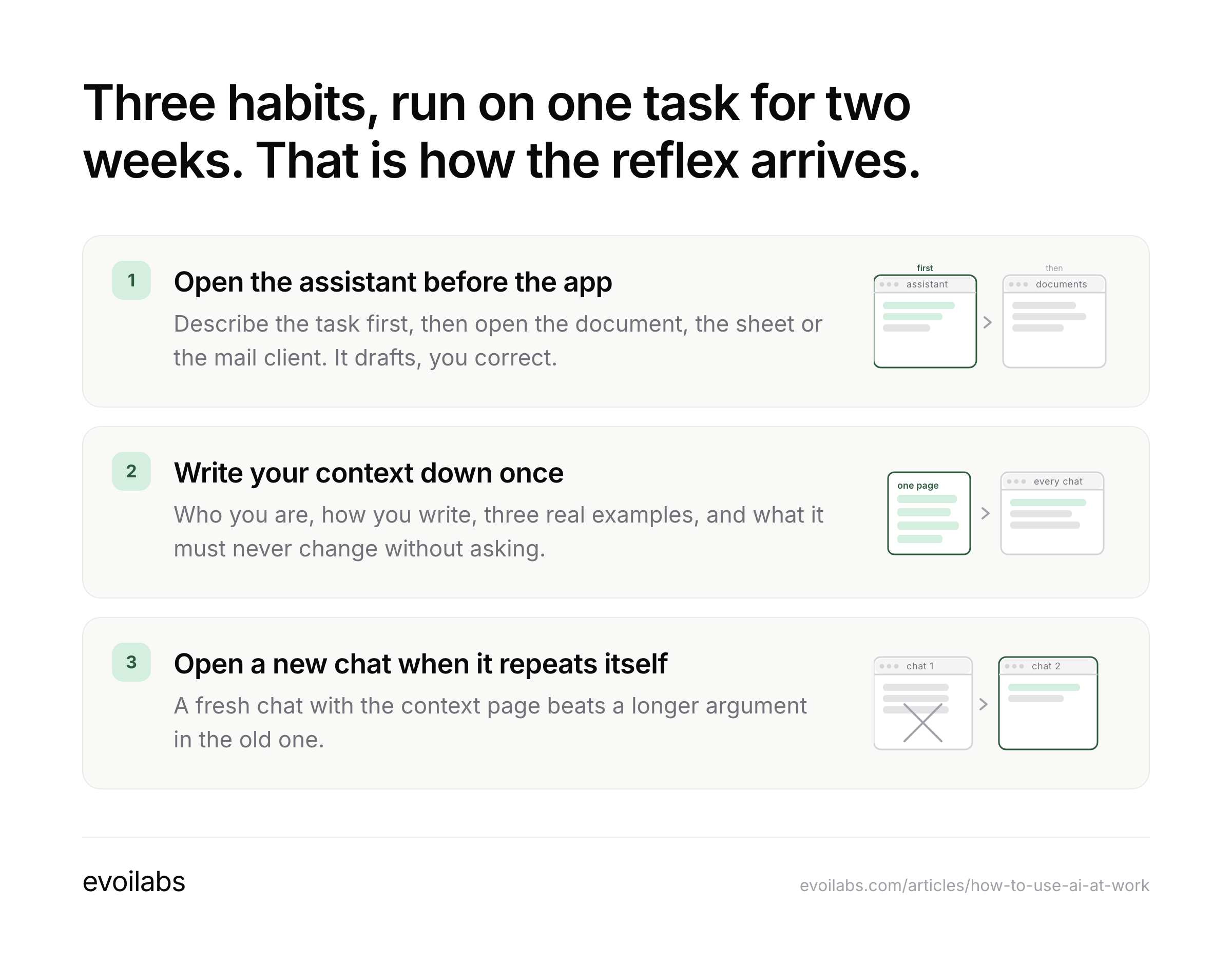
Run those three on the one task for two weeks. Then check one thing: do you still need to remind yourself to open the assistant at the start of that task? If the answer is no, you have the reflex, and the next task is yours to pick.
What "putting the rules in" means
A manager at a mid-size company asked me where to start and how to put the rules in. The rules are that context page. It takes about an hour to write the first version, and everything you do afterwards inherits it, which is why it's worth writing before anything clever. Include the privacy line: what data the assistant may see, what it may not, and where the data-sharing switch is in the tool you use. That line is also the one clients ask about.
evoilabs
It starts with one task.
Everyone wants AI. No one knows where to start. We pick the one task your team repeats every week, build the system that handles it, and show your team how it was built so they can do the next one themselves.
The measure that counts
The client with the time sheet did his own arithmetic: "If I gain four, five, ten hours a week, that's as many extra clients." Time saved is only worth counting as capacity you can use. One task gives you an hour. The reflex, applied task by task over six weeks, is where the hours add up.
If, after two weeks, you still need the reminder
Run the two-week test first. If you still need a reminder to involve the assistant on the task you chose, book a thirty-minute fit call and bring the file or tool involved. I do this with founders in four to eight weeks, on your machine, one task per session, and I leave with the context page in your hands.